Public Preparedness for AI Risks: Capability-Risk Communication Asymmetry in Frontier AI Labs’ Outputs
In this Article
The fields working at the frontier of AI development are not in consensus on what exactly the future of AI will look like — there are proponents of Artificial General Intelligence (AGI), proponents of Artificial Superintelligence (ASI), proponents of coordinated powerful agents as the future of AI, and there are critics and skeptics of these forms of AI, and of AI reaching any super or powerful form of intelligence. In fact, within each sub-community, for example, within the AGI sub-community, there is no consensus on what this form of super AI would look like. What must be attained for AGI to be AGI (McLean et al., 2023) ?
Nonetheless, there is at least a consensus that powerful AI is arriving soon. Different timelines have been proposed for the arrival of powerful, broadly diffused AI (Altman, 2025; Amodei, 2024; Angelo, 2026; Larsen et al., 2026), and with these predicted timelines are further predictions regarding how much broadly diffused, powerful AI could reset our world as we currently know it. Our world is not new to technology-based resets; the computer, personal computers specifically, mobile phones, the internet, and even social media have had global, multi-faceted influences on our world. Yet, it is said that the effects of broadly diffused, powerful AI — even the effects of AI as we see them currently — will likely outdo and supersede the effects of every other type of technology-based resets our world has seen (Gairola, 2026; Hassabis, 2026; Prakash, 2023).
It is established that powerful AI will arrive soon, be broadly diffused, and have global, deep-seated effects. Some researchers have modeled pathways through which advanced AI or artificial superintelligence could produce a global catastrophe, including human extinction (Barrett & Baum, 2017; McLean et al., 2023). The expected risks of powerful, insanely capable, and broadly diffused AI are such that the industry statement on mitigating AI risk requests a level of prioritization comparable to the work done in mitigating risks from other global, societal-scale risks ((Center for AI Safety, 2023). Humans have faced global crises stemming from scalable risks in the past. Historically, we have often been under-prepared, such that these crises catch us off-guard and have far-reaching, devastating effects on the global populace. A classic, relatively recent case in point is the world’s preparedness and response to the Covid-19 pandemic (COVID-19 National Preparedness Collaborators, 2022). We also love to claim that we learn from history to better prepare for future risks. However, we may as well be on the infamous path we took regarding other global risks, when it comes to AI. If powerful AI were to be diffused tomorrow, or in the next few months, or even a couple of years from now, the world would not be ready. This is evident in several of the things happening currently.
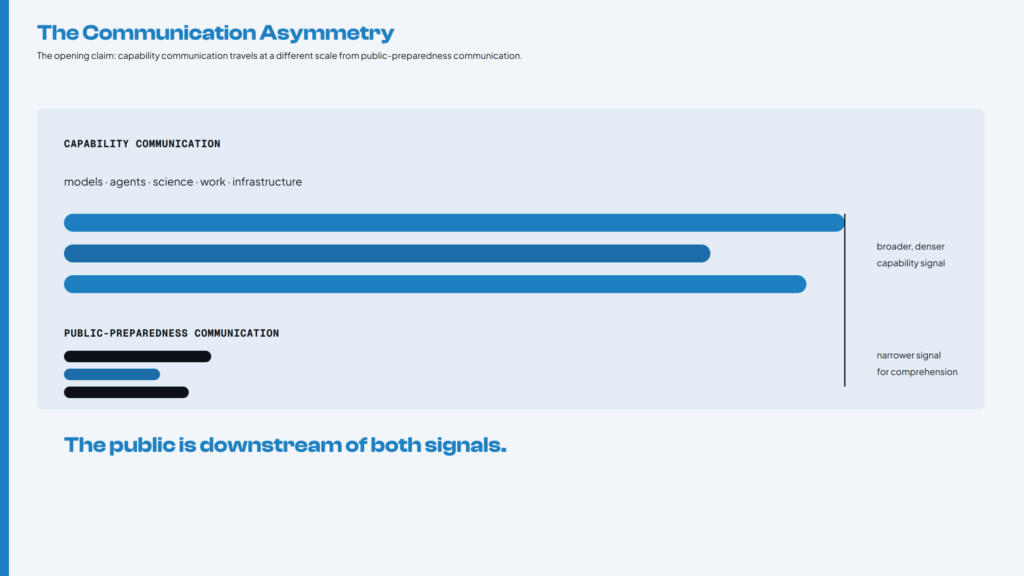
There is an asymmetry in information dissemination, such that the bulk of the world’s peoples are starkly ignorant of the capabilities of even today’s frontier models, or of how far AI models and agents have come in capabilities on both short-term and long-horizon tasks (METR, 2026). Juxtaposed against this deep dearth of information, which I sometimes refer to as people simply just being aware of broader, low-level capabilities such as AI content creation and AI image generation, is the deeply aware but small and enclosed community, which I have described in the past as the cyclical AI bubble, and which Andrej Karpathy seemingly also referenced within his broader thesis on the growing gaps in the understanding and perception of AI capability. I would argue that Karpathy’s growing gaps thesis is applicable to AI risks too, such that the majority of the people, and even more so, a good percentage of people who are aware of the understanding and perception of AI capability, are unaware of the extent to which AI risks extend.
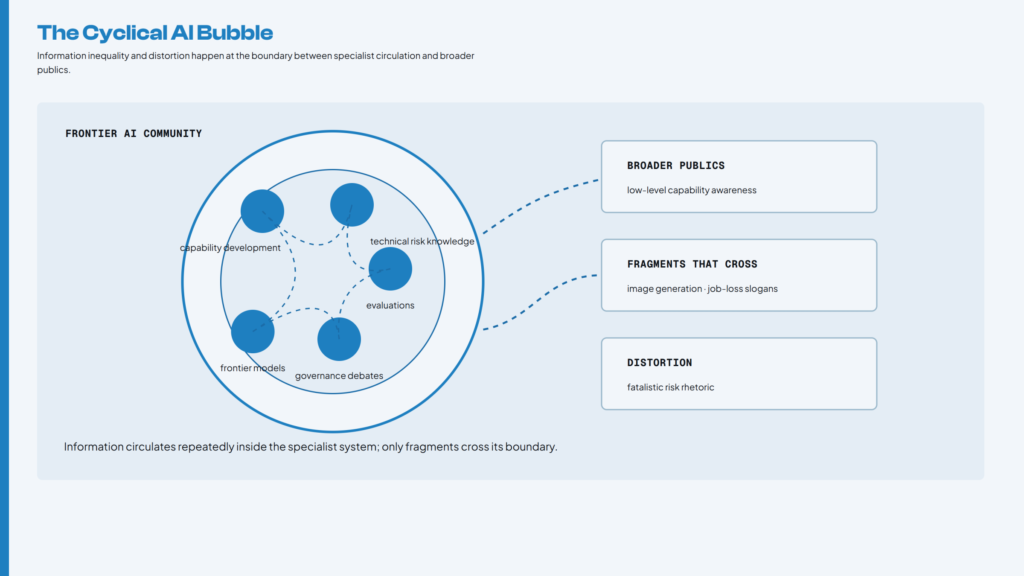
On the other hand, there is also the notion of people being misinformed about AI risks. This is evident in the most popular rhetoric about AI risks among the broader populace: “AI will take my job and yours,” “We will be in the permanent underclass,” and the like. Do not get me wrong, economic disempowerment (Kulveit et al., 2025) and labor replacement (Goldman Sachs Research, 2025) are indeed valid AI risks. However, these risks are being platformed and represented in ways that signal doomsday and fatality to the populace, all the more so to the younger and emerging population.
It is true that safety organizations, watchdogs, and think tanks — such as METR, Andon Labs, Apollo Research, and Redwood Research — are doing incredible work to disseminate information regarding AI risks, AI safety, and AI capabilities. Some frontier labs are also doing good work regarding these. However, the fact remains that no one has their fingers on the pulse as much as the frontier AI labs. And, given what the world’s preparedness for insanely capable, powerful, and broadly diffused AI is, I would argue that these frontier labs are not doing nearly enough regarding AI risk communication. Better put, this prototreatise builds its argument around the thesis that AI labs (using selected frontier labs as the sample) overrepresent AI capabilities in their public communication, when compared to risk communication. It is not rocket science that these AI labs are incentivized to speak strategically and intensely about AI capabilities. The structural asymmetry between AI capabilities and AI risk communication could be attributed to the benefits of AI capabilities communication, such as lobbying policies, fundraising, signaling value, government backing, IPOing, attracting more enterprise clients, and attracting more users. Essentially, AI labs speaking about AI capabilities — and especially the increasing capabilities of their own models — is a strategic no-brainer. However, since life runs on economics and resources are finite (regardless of how much AI labs have raised), the seeming opportunity cost of AI labs’ communication about AI capabilities is a lack of strategic, broadly diffused communication that builds public preparedness for AI risks, and its attendant outcome of our world being ill-prepared and unready for powerful, insanely capable, and broadly diffused AI.
Sampling written communications from OpenAI, Anthropic, and Google DeepMind across X (Twitter) and the companies’ official websites, this prototreatise examines the state of risk communication regarding AI and how this compares to the state of AI capabilities communication. The data analyzed also lends argumentative strength to the claim that the synthesized data. I also strengthen the argument that AI risk communication is structurally underrepresented, and that this underrepresentation could be devastating for humanity, if not systematically addressed.
Defining Terms and Concepts
This prototreatise makes use of terms and concepts, some of which are measured or at least evaluated in my data analysis. As such, it is useful to start off by defining and clarifying what I mean by powerful AI, AI capabilities communication, risk communication, and public-preparedness risk communication.
Powerful AI within the context of this prototreatise is defined as AI that is insanely capable of executing on nearly all, if not all, the tasks and jobs in the economy, has perpetual knowledge, can continually learn, is contextually and temporally aware, can recursively self-improve, can work for longer horizons matching human workers, and is autonomous and not necessarily needing human supervisors or direction. I do not think the current setup — the training architecture, user interface, training data, training priorities, compute, memory, and broader resources — of current LLM models can get us there. However, that is an argument for another piece. Essentially, to then describe broadly diffused powerful AI means that this AI, as described above, is available within the broader population, occasioned by economic, technological, or mixed shifts that have made this possible.
I also need to clarify that AI capabilities communication, as used in this work, refers to strategic communication whose primary function is to foreground what AI systems can do, what they enable users, enterprises, or institutions to do, how their performance is improving, where they can be deployed, or how AI capabilities are advancing. AI capabilities communication could take any format or be further classified into other categories (reports, announcements, research reports, whitepapers, or what have you), however, the most important thing is that this type of communication advances the goal of communicating increasing AI capabilities. As such, communications around model launches, product or feature announcements, benchmark or performance claims, demos, coding, science, agent, enterprise, or productivity claims, multimodal generation claims, robotics or tool-use claims, deployment reports, infrastructure, and ecosystem announcements that paint AI capability as more usable, scalable, deployable, interoperable, or normalized, will fall squarely within AI capabilities communication. This is not necessarily an established subtype of strategic communication. However, it is increasingly seen in communication outputs within the AI industry.
On the other hand, risk communication can be broadly defined as “the exchange of information among interested parties about the nature, magnitude, significance, or control of a risk (Covello, 1992, p. 359). The conceptualization of risk communication within a broader sense recognizes the interactivity of the communication process, wherein individuals, groups, and/or institutions exchange opinions and information regarding risk (National Research Council, 1989) . This also frames risk communication within broader risk governance and public engagement practices. This conceptualization of risk communication is in the third phase within Leiss (1996) documentation of risk communication’s evolution. The first phase was information-heavy and largely focused on the quantitative expression of risk estimates. It favored the mechanical and logical, perhaps on the assumption that everything else was held ceteris paribus, and that the risk estimates would be the core factor for public decision-making. The second phase started to shift away from this technically overwhelming approach towards the elements of successful communication (such as the source’s credibility, message clarity, the clarity of the message, and a focus on the needs and perceived realities of the audience). While this was a welcome shift, it also heavily prioritized elements that could sometimes be nothing but extraneous to the public’s decision-making process. The third phase, in understanding that risk communication is laden with trust issues (and rightly so), relies on the social context presumption that “despite the controversial nature of many risk management issues, there are forces at work also that favor consensus building, meaningful stakeholder interaction, and acceptance of reasonable government regulatory framework (Leiss, 1996).” Essentially, the third phase of risk communication is one where risk communication is not merely persuasive for internal strategic purposes, but one where risk communication is more calibrated towards a shared, overarching goal. This approach has fueled risk communication during global-scale crises such as the Covid-19 pandemic — wherein the overarching, shared goal is to ensure humans are safe and protected from the virus, such that sub-goals (such as companies’ internal strategic ambitions) were subsumed under this shared goal that dictated the direction for communication.
Nonetheless, Reynolds and Seeger (2005) describe risk communication as an effort whose goal concerns “the probabilities of some harm and associated methods for reducing the likelihood of such harm becoming reality (p. 48).” Therefore, risk messages embody the scientific and technical understanding of risk factors and the social and cultural beliefs regarding the said risk, thus giving a holistic view of what the risk is, how it is being manifested, people’s perceptions of the risk, and further, the publics’ likelihood of responding positively or negatively to the risk messages, especially if an element of self-efficacy or public action is necessary for reducing the likelihood of the risk becoming reality (Reynolds & Seeger, 2005). Furthermore, institutions and organizations often deploy risk messages as a way to address the cultural or social factors influencing the perceptions of the said risk, by translating, operationalizing, and then diffusing the technical understanding of the risk and its factors into behaviors, through persuasive techniques .
Understandably, a company’s outputs can communicate risk while serving other strategic goals. Boholm (2019) noted that institutional risk communication is not always public-serving, as some organizations may use risk communication for other strategic goals such as informing the public, calming and reassuring their audiences, legitimizing their brand, managing trust, or even preserving brand authority. Furthermore, instrumental approaches to risk communication may be structured around securing acceptance of an institution’s preferred risk-management or technology-policy outcome, rather than opening the underlying decision to substantive public deliberation (Wardman, 2008).
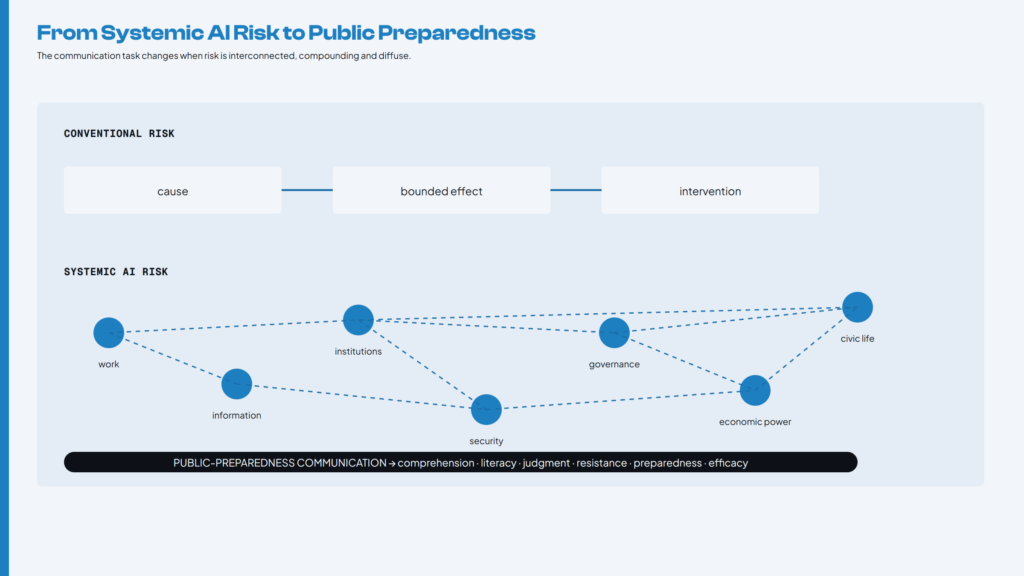
The risk communication strategy to be adopted and the effectiveness of risk communication generally depend heavily on the nature of the risk in question. Schweizer et al. (2022) distinguish between two natures of risks: conventional risks and systemic risks. Since conventional risks have a linear path, they can often be effectively addressed through interventions that target their cause-and-effect chain. However, systemic risks are high-complexity, transboundary risks with nonlinear cause-and-effect patterns and probabilistic relationships. As such, addressing systemic risks effectively requires strategic, multi-level, interdisciplinary interventions that sometimes include behavioral, environmental, societal, and even economic sub-interventions. Schweizer et al. (2022) also note that these systemic risks are often volatile with several tipping points, and they are further complicated by the fact that they hardly receive enough public attention. Catastrophic risks are a prime example of this. The Covid-19 pandemic was devastating as a systemic, slow-developing, but seemingly inevitable risk — or at least, the general possibility of a pandemic was foreseeable, even though its timing, origin, and particular manifestation were not (Gertler & the 80,000 Hours team, 2026).
If these systemic risks often fly under the public radar, are volatile, seemingly Hydra-headed, and dangerously devastating, should they become full-blown crises, then, it is necessary for our world to adequately prepare for them. This is the category within which this work classifies the all-encompassing term of AI risk and its embedded risks, such as concentration of power, government takeover and global wars, among others. Furthermore, this prototreatise argues that a lack of risk communication uniquely calibrated towards effectively preparing the public for the myriad of risks that powerful, broadly diffused AI poses is an AI risk in itself, and a high-priority one at that.
Thus, I conceptualize public-preparedness risk communication as an interactive process involving risk messages and risk communication efforts that are primarily geared towards providing the different stakeholders and publics with relevant information for informed decision-making, thereby helping them build comprehension, AI literacy skills, resistance to misinformation, disinformation, and malinformation, and understanding of and efficacy towards the probability of AI risks becoming reality. This conceptualization of public-preparedness risk communication leans heavily towards the peculiarities of systemic and global-scale risks, adapting the pragmatic, skill-building, and self-efficacy orientation of risk models often applicable to health risks and crises such as the CERC, PADM, and IDEA models (). However, a point of deviation from these otherwise fitting models is that AI risks cannot be really classified as acute risks. They present as slower onset risks that build over time and compound. Thus, while humanity can greatly benefit from AI risk communication that optimizes for public preparedness, better awareness of the risks, and adequate workforce and human resource development and readiness, the difference in the nature and type of risk these communication models and my conceptualization address is not to be trivialized.
Approach
This work sought to answer the question: is risk communication — specifically risk communication as conceptualized within this work (public-preparedness risk communication) — structurally underrepresented in the communication outputs of frontier labs, especially when compared to capabilities communication? To answer that question, I followed a directed qualitative content analysis approach. Hsieh and Shannon (2005) classify directed content analysis as an approach where prior research or theory informs the analysis process. In line with the processes Hsieh and Shannon (2005) highlighted, I first identified concepts that define the scope of my work (capabilities communication, AI risk communication, public-preparedness risk communication) as my initial coding categories. Then, these conceptualized terms served as the a priori categories for the analysis (Hsieh & Shannon, 2005). Following this, I developed operational definitions for these categories, which then enabled me to develop a unified codebook.
Data Collection
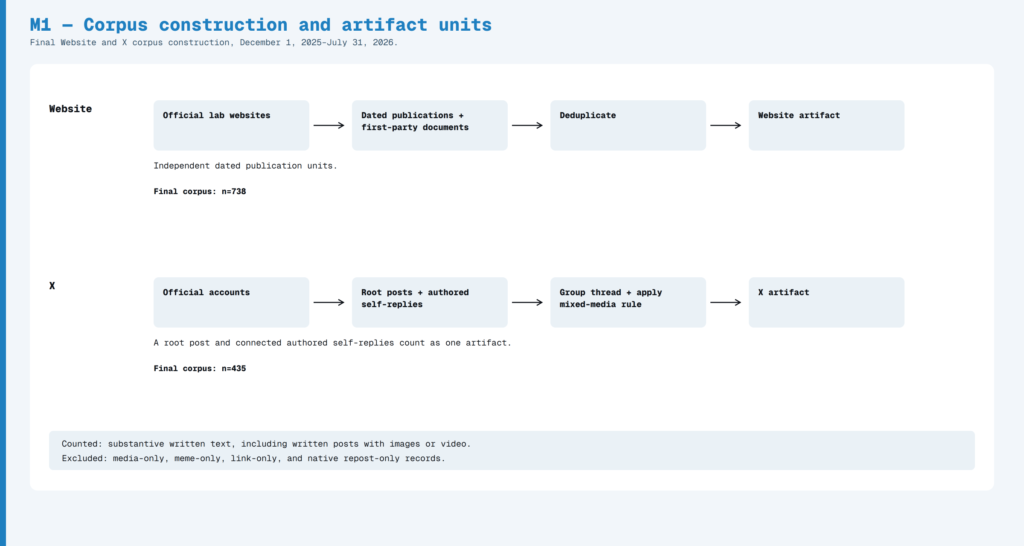
The data collection focused on written communication artifacts as the unit of analysis. Since there are several AI labs and I do not have the resources to analyze communication from the full AI lab population, I made the methodological choice of sampling three frontier AI labs: OpenAI, Anthropic, and Google DeepMind. People have different criteria for classifying AI labs. In this work, I recognize frontier AI labs based on Longterm Wiki’s classification as a first-level criterion, while also prioritizing labs that have had robust communication across the two sites of analysis (official website and X) within the analyzed period.
AI (in this case, Hermes Agent and OpenAI Codex) was useful for data collection, reconciling texts across different data extraction methods, text recovery, and data organization. For the website, I tasked Codex to compile dated first-party publications from the official websites of Anthropic, Google DeepMind, and OpenAI. The website inventory covered December 1, 2025, through July 31, 2026. For each lab, Codex and its sub-agents pulled data from official publication indexes, RSS feeds, sitemaps, research and news pages, model-card repositories, and internally linked first-party reports or PDFs. Publications that were linked from another owned publication (e.g., a report published on OpenAI’s website that was then promoted via an announcement) were considered standalone artifacts, provided they had a title, publication date, and substantive content. Furthermore, duplicate URLs, alternate representations of the same publication, undated landing pages, rolling pages, and non-independent supporting materials were excluded from the data count. Following hours of data extraction, including manually opening 67 OpenAI pages in Codex’s in-app browser (after an initial 403 error via other means), the final website corpus contained 738 dated publications: 193 from Anthropic, 123 from Google DeepMind, and 422 from OpenAI.
For X, I tasked Hermes Agent, and eventually Codex, with collating written communication from the official accounts of the sampled labs: @AnthropicAI, @GoogleDeepMind, @OpenAI, and @OpenAINewsroom. OpenAI Newsroom had to be included in the accounts for analysis, since OpenAI handles the scope of communication this prototreatise is interested in via two distinct channels.
The X collation similarly covered posts published between December 1, 2025, and July 31, 2026. A standalone post was treated as a single communication artifact. Furthermore, threads with self-replies were considered as a single artifact. A standalone root post was treated as one communication artifact. A root post and its connected authored self-replies were treated as one artifact. Native reposts without substantive authored commentary from the account being analyzed were excluded. Furthermore, mixed-media posts (e.g., a video with written communication as its caption) were retained where the written text independently conveyed a communicative purpose. Thus, having a video, image, or link did not disqualify an artifact; however, artifacts that had media only, were a meme, had a link or image-only, or had other non-written items were excluded where the written content did not independently communicate a countable goal. Given that X search and account endpoints represented self-replies separately, the collected status records were reconciled into artifact-level records. The reconciliation retained the root URL, member status URLs, full captured text, account, date, thread membership, and exclusion status for all artifacts involved. In cases where an earlier source record bundled independent posts, the posts were separated when their reply relationships showed that they belonged to different root communications. Thus, posts were allowed to stay as a bundled, single artifact only when they formed a connected authored self-reply chain.
Following hours of data extraction, including manual data extraction by me for 33 posts that were originally inaccessible across OpenAI’s two accounts, the resulting analytic corpus contained 435 artifacts: 134 from Anthropic, 114 from Google DeepMind, and 187 across OpenAI and OpenAI Newsroom.
Coding Scheme
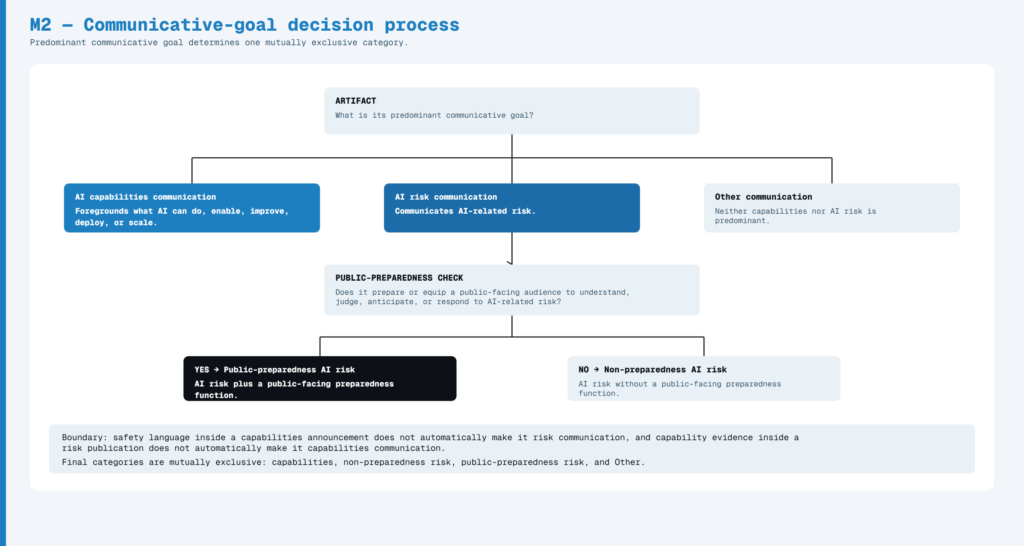
In this work, I examine the presence (or otherwise) of structural asymmetry between capabilities and risk communication in the AI sector using the communicative goal of an artifact as a classifier to measure the volume of output from each lab, and also on aggregate. Since the argument concerns the structural underrepresentation of public-preparedness risk communication, volume provided the most direct measure of how much of the sampled communication was devoted to public-preparedness risk communication, relative to capabilities communication.
Communicative Goal
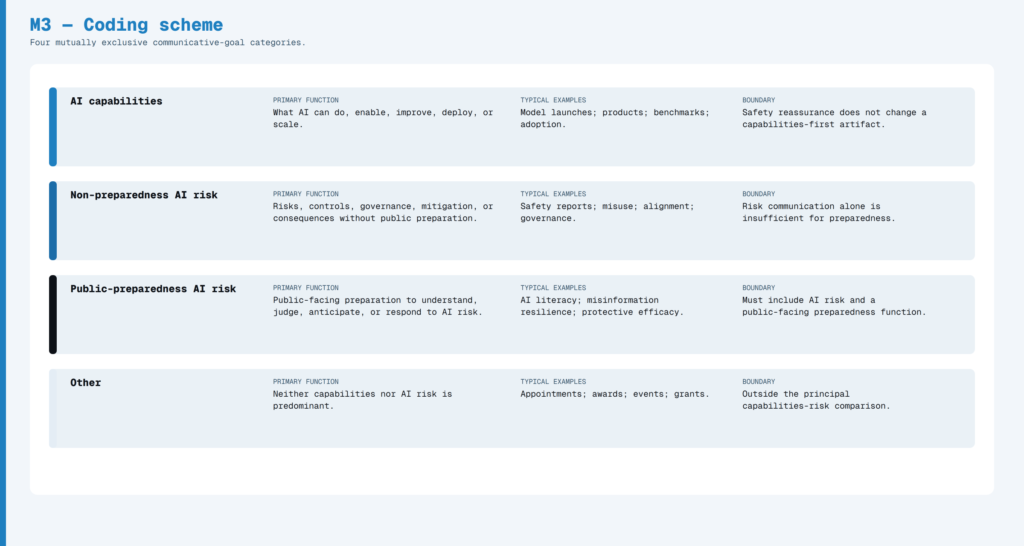
The principal coding decision concerned the artifact’s predominant communicative goal. Predominance was determined from the title or opening statement, the proportion and specificity of the message devoted to each possible goal, its conclusion or call to action, its apparent intended audience, and what the communication ultimately asked that audience to know, value, judge, adopt, or do. Where a given artifact had more than one communicative goal, the dominant or overarching communicative goal was adopted. For instance, if an artifact promoting OpenAI’s strategic collaboration with Nvidia to ramp up ChatGPT capabilities had a paragraph spotlighting recent risks, the piece would be considered primarily AI capabilities communication.
Thus, I conducted the coding process in two stages. The first stage assigned a provisional communicative goal code to each artifact and identified cases requiring further review. Following the refinement of the operational definitions of the work’s concepts, the two corpora were re-read against a unified codebook. The final record for each artifact contained its communicative goal, a confidence assessment, a coding rationale and, where applicable, and its classification. Differences between the provisional and final decisions were retained in the adjudication records.
The coding did not rely on the occurrence of particular words or on the institutional section in which an artifact appeared. Therefore, the presence of safety language did not automatically make an artifact risk communication, just as the presence of capability evidence did not automatically make it capabilities communication. Three predominant goal categories were then applied: AI capabilities communication, AI risk communication, and Other communication.
An artifact was coded as AI capabilities communication when its primary function was to foreground what an AI system could do, enable, improve, automate, scale, deploy, interoperate with, or make more usable. This included model and product launches, demonstrations, benchmark and performance claims, coding, science, agent and productivity claims, deployment reports, infrastructure announcements, ecosystem developments, and accounts of AI adoption or normalization. Safety or risk material contained within these artifacts did not alter the code, where it primarily reassured audiences that the capability being presented was safe, aligned, trustworthy, or ready for use.
The AI risk communication category was assigned to artifacts whose primary function concerned the nature, magnitude, consequences, distribution, governance, mitigation, or control of risks created or amplified by AI. This included communication about model behavior and alignment, misuse, AI-enabled cyber or biological harm, misinformation and manipulation, labor and economic disruption, concentration of power, autonomy and loss-of-control pathways, and broader social or institutional consequences. Ordinary software incidents, account-security notices, service disruptions, legal or corporate statements, and conventional product support were not coded as AI risk unless the artifact itself established a substantive connection to risks created or amplified by AI.
Other communication covered artifacts whose predominant goal was neither the communication of AI capability nor the communication of AI risk. This included corporate appointments, awards, events, grants, philanthropy, ordinary organizational affairs, conventional operational notices, and other institutional communication falling outside the principal comparison.
The work then extended into sub-categories within the risk communication category. The presence or absence of a public-preparedness focus (as explained in the terms section) was assessed only after an artifact had been coded as AI risk communication. Thus, an AI-risk artifact qualified as public-preparedness risk communication when it met two conditions. First, it had to concern a risk associated with powerful or broadly diffused AI, or a present-day AI risk that informed that broader trajectory. Second, its primary function had to involve preparing or equipping the public to understand, judge, anticipate, or respond to that risk.
The preparedness function could involve building comprehension, AI literacy, resistance to misinformation, disinformation or malinformation, anticipatory preparedness, protective or civic efficacy, workforce or economic readiness, governance capacity, or meaningful participation in decisions concerning AI risk. It did not have to contain a direct instruction, but it had to provide an intelligible, public-facing layer that equipped the public with the means to comprehend, judge, prepare, or respond (see the image below for examples).
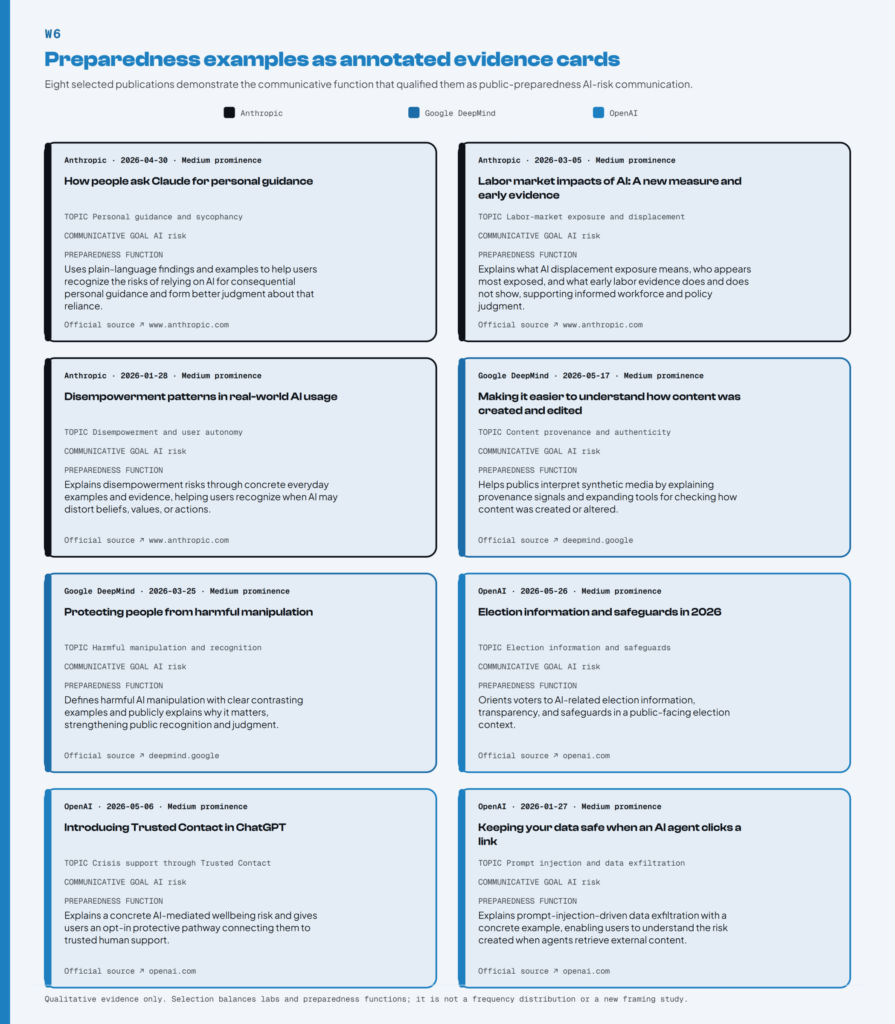
The public availability of risk information did not by itself make an artifact public-preparedness communication. Technical safety research, expert-facing evaluations, institutional frameworks, policy signaling, organizational mitigation claims, and institutional reassurance were coded as non-preparedness AI risk when they lacked the required public-facing preparedness function. Likewise, an actionable instruction did not by itself establish public preparedness. A conventional software update, password reset, product recall, service notice, or isolated security remediation did not qualify without a substantive connection to AI-caused or AI-amplified risk.
Essentially, artifacts initially classified as AI risk communication were then further classified as either public-preparedness AI risk communication or non-preparedness AI risk communication. The four final display categories were therefore AI capabilities communication, non-preparedness AI risk communication, public-preparedness AI risk communication, and Other communication.
Establishing each artifact’s communicative goal was the primary coding task required to then execute on the volume dimension.
Results
This prototreatise set out with an argument that there is a structural asymmetry between communication about AI risk and communication about AI capabilities, considering that frontier AI labs are the best positioned to communicate with the public regarding both. This section now turns to whether, and to what extent, the collected data support that argument. The findings are organized around the following questions:
- What did the selected labs communicate during the period of analysis?
- How did labs’ communications vary by category?
- How did this communication vary by lab and channel?
The report will follow a process where I will generally report public-preparedness risk communication separately from non-preparedness risk communication. However, in contextualizing the magnitude of the underrepresentation (as you will soon find out), I will sometimes report total AI risk communication too. Furthermore, the report of my findings will use percentages, counts, and multiples, all to contextualize the data.
1. Volume
1. 1 Selected frontier AI labs’ communication during the period of analysis
Website publications by all three labs within the period of analysis totaled 738, while X posts totaled 435. On the labs’ website, capabilities communication accounted for 66% of all publications, totaling 487. Non-preparedness risk communication accounted for 19.5%, totaling 144. Public-preparedness risk communication accounted for 7.2%, totaling 53, while Other accounted for 7.3%, totaling 54. Of all the categories measured, public-preparedness risk communication was the least represented in the labs’ communication efforts, as featured on their websites.
The analysis revealed that AI capabilities communication takes a similar percentage share of X artifacts as it did for website artifacts (63.4%, totaling 276 artifacts). Non-preparedness AI risk communication taks 13.3%, totaling 58 artifacts, public-preparedness risk communication takes 5.3%, totaling 23 artifacts, and is similar to its representation percentage share on the website. Unlike the website, the Other category ranks second to AI capabilities in output volume on X, accounting for 17.9% of the share, with 78 artifacts (see Image 6 below).
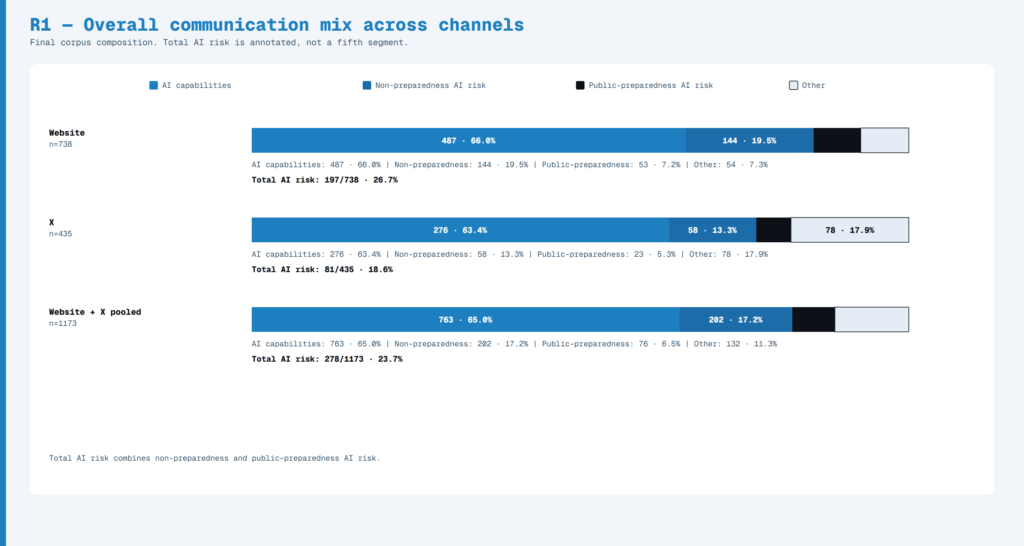
When artifacts from both sites of analysis are pooled together (totaling 1,173 artifacts), AI capabilities communication still accounts for more than half of the output volume, at 65%, with 763 artifacts. Non-preparedness risk communication accounts for 17.2%, totaling 202 artifacts, public-preparedness risk communication accounts for 6.5%, totaling 76 artifacts, while Other accounts for 11.3%, with 132 artifacts. Across all levels of examination, public-preparedness risk communication is the only category that consistently records single-digit percentage shares of the total.
Regardless of the foregrounding in this piece, wherein I made a case for public-preparedness risk communication as a conceptualized version of risk communication worthy of research, some critics might argue that this is a personal “carving” of the well-known concept of risk communication, in a way that serves a strategic agenda. I would think my foregrounding details enough to show that this is far from the case. If it does not work for some, let us then consider risk communication without the qualifiers. The question remains: is risk communication (preparedness or not) structurally underrepresented? So, in examining risk communication it its entirety within the context of the analysis, we see that the sampled AI labs’ communication efforts were geared towards AI capabilities at 2.7x the rate they were geared towards AI risks (given the volume count per category). Furthermore, more than half of all artifacts across the three labs and the two channels are about AI capabilities, specifically at 65%, while only 23.7% is about AI risks. This asymmetry is also consistent at the channel level, where the labs’ websites published about AI capabilities at 2.5x the rate at which they published about AI risks; for X, the rate is 3.4x. (see Image 7 below).
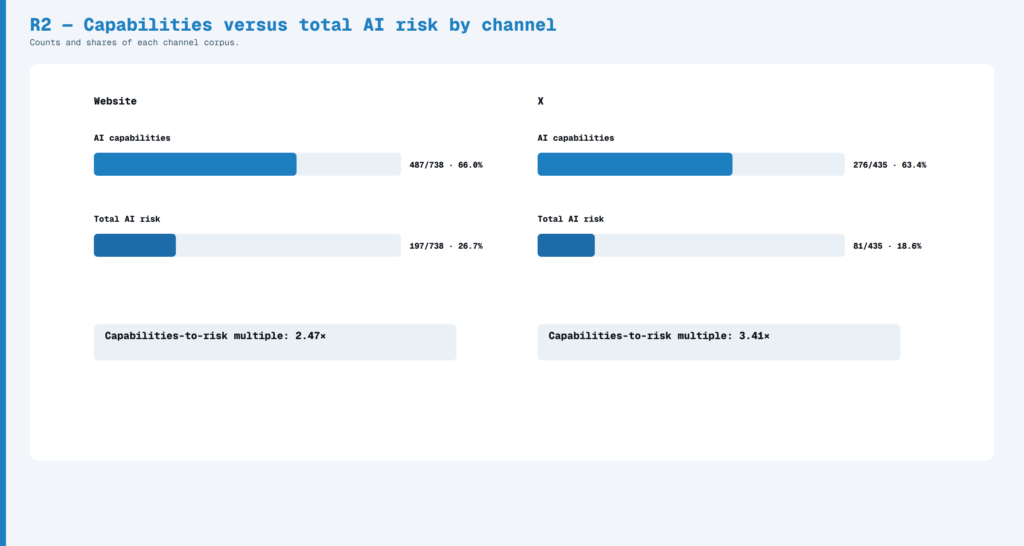
Essentially, the argument that AI capabilities communication is overrepresented in AI labs’ communication compared to AI risk communication is validated when we examine the volume of communication output across two of the most widely used communication channels in the AI industry/sector.
1.2: Capabilities Communication vs. Public-Preparedness Risk Communication: A Lab-level Analysis
Given the general findings revealing the underrepresentation of public-preparedness risk communication (or any form of risk communication at all) in frontier AI labs’ output volume, it is important to examine communication behavior at the individual level, which further helps us understand the severity of the problem.
Anthropic
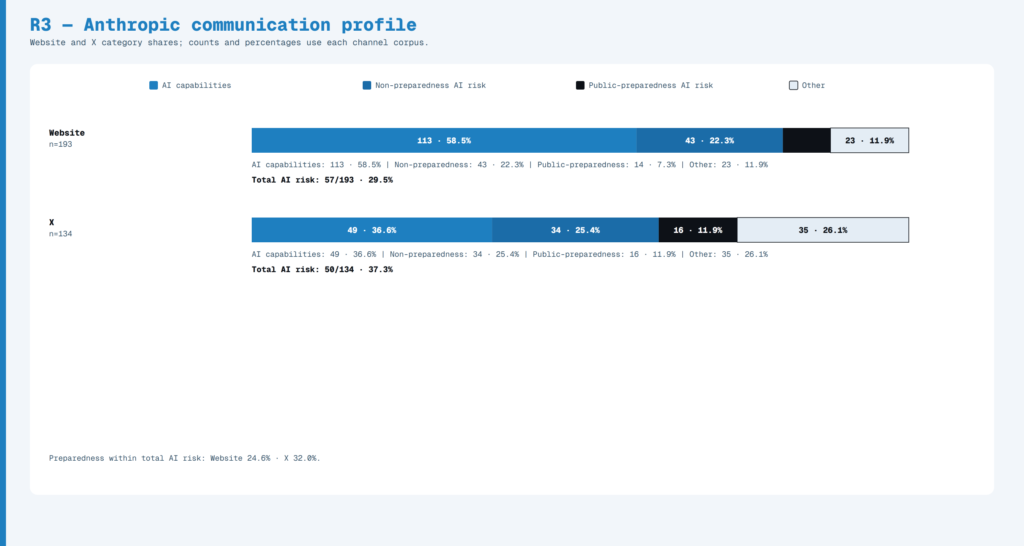
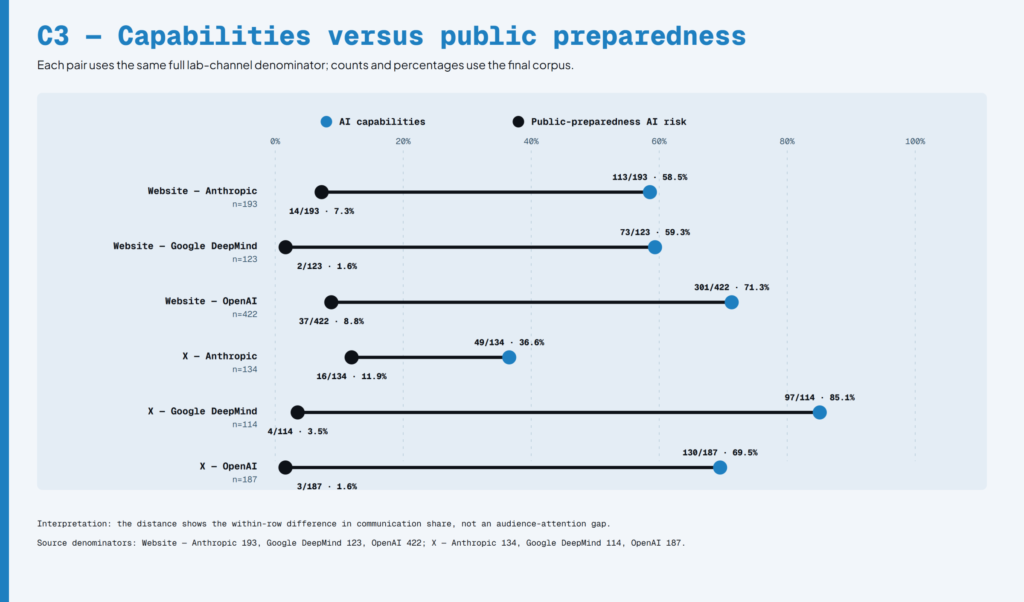
Anthropic published 193 communication artifacts on its website within the analysis period, 58.5% of which fall under capabilities communication, totaling 113. Non-preparedness risk communication artifacts account for 22.3%, totaling 43; public-preparedness risk communication accounts for 7.3%, totaling 14, while Other accounts for 11.9%, totaling 23. In line with the aggregate public-preparedness website count, Anthropic’s output volume for this category is a single-digit percentage of the total. Hence, Anthropic’s website pushed out publications about AI capability gains and increasing capabilities at 8.1x the rate it published about public preparedness for the risks of these increasing AI capabilities, during the analysis period.
On the other hand, Anthropic’s X account has 134 artifacts, with 36.6% being AI capabilities communication, totaling 49. Non-preparedness risk communication accounts for 25.4%, totaling 34; public-preparedness risk communication accounts for 11.9%, totaling 16, while Other accounts for 26.1%, totaling 35. Capabilities communication is still the prevailing content type. However, Anthropic’s X account saw a contraction in that category for the analysis period, while public-preparedness also got a double-digit percentage share, although the output count then makes this less impressive. Essentially, Anthropic’s X artifacts seem to have a relatively close representation between AI capabilities communication and AI risk communication (given that the total AI risk communication from Anthropic’s X artifacts is at 32%).
Nonetheless, while Anthropic made considerable efforts to publish more risk communication content on X, comparable to its communication about Claude’s capabilities, the larger share of this risk communication is still not content designed to improve or contribute to public preparedness and readiness for insanely powerful and broadly diffused AI.
Google DeepMind
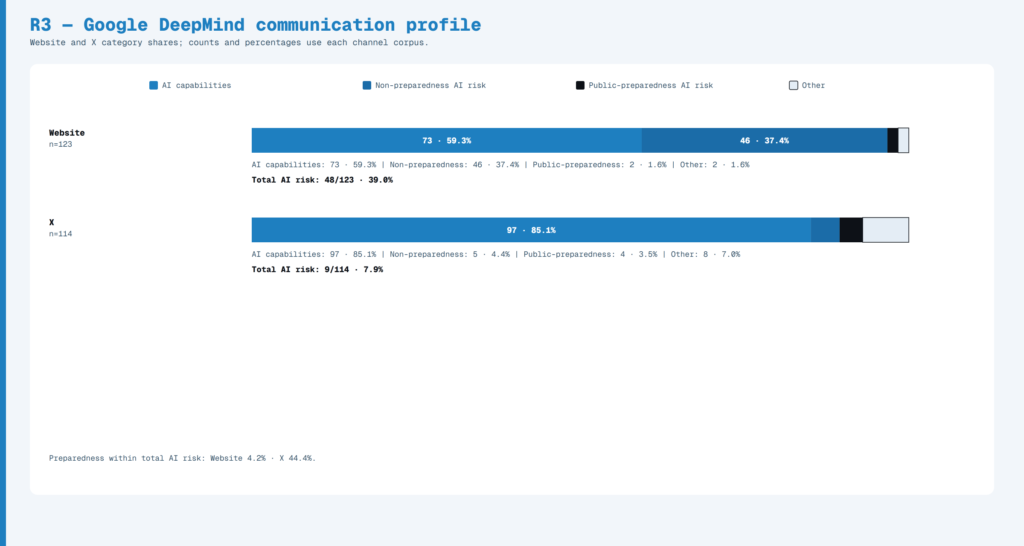
Google DeepMind 123 communication artifacts on its website within the analysis period, 59.35% of which fall under capabilities communication, totaling 73. Furthermore, non-preparedness risk communication artifacts account for 37.4% (46 artifacts); public-preparedness risk communication and Other both account for 1.63% each, with just 2 artifacts recorded per category. Google DeepMind’s website publications show a dearth of public-preparedness risk communication, further widening the asymmetry and are also in line with the single-digit percentage total of the aggregate. In fact, the lab’s structural underrepresentation of communications about public readiness for AI risks on its website is infinitesimal, both in percentage share of total communications and in count. Also, in line with the aggregate public-preparedness website count, Google DeepMind’s output volume for this category is a single-digit percentage of the total. Worse still, the lab’s website pushed out publications about AI capability gains and increasing capabilities at 36.5x the rate it published about public preparedness for the risks of these increasing AI capabilities.
The lab’s X profile is not any better for public-preparedness AI communication. Of the 114 artifacts published, 85.1% (97) fall under AI capabilities communication. Non-preparedness AI risk communication accounts for 4.4% (5 artifacts); public-preparedness AI risk communication accounts for 3.5% (4 artifacts), while Other accounts for 7% (8 artifacts). Google DeepMind’s intensified communication about AI capabilities on its X account is such that communication about any other topic, including AI risks, is severely underrepresented, and this can be better understood by considering that the lab’s X artifacts about AI capabilities were 24.3x as many artifacts about the public preparing for AI risks (based on analyzed data).
OpenAI
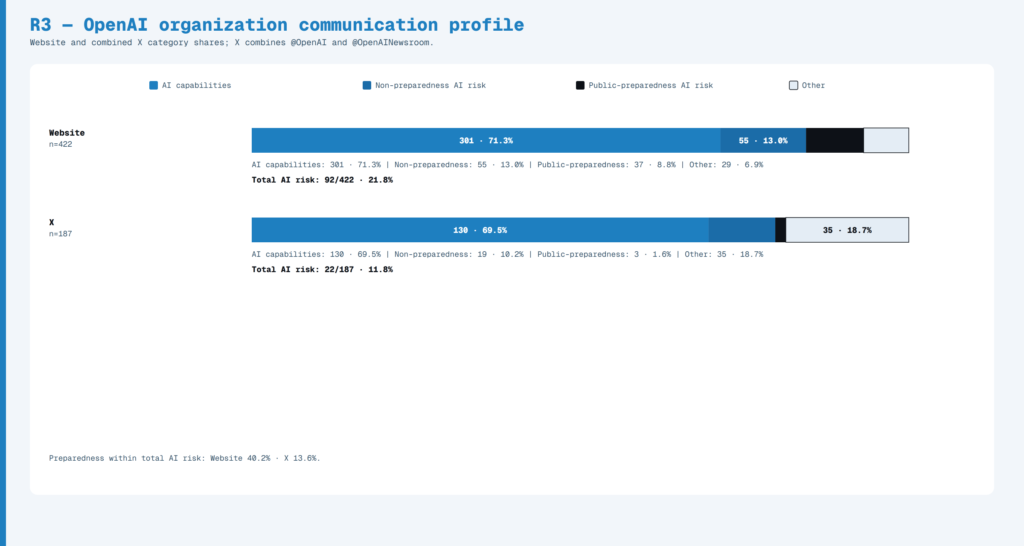
OpenAI has the highest output volume of any lab during the analysis period, and this is not simply a function of running two X accounts, as it holds for both the pooled volume and the output volume per channel (website and X). The lab published 422 communication artifacts on its website during the analysis period, of which 71.3% (301) have AI capabilities as their communicative goal. Non-preparedness AI risk artifacts account for 13% (55) of the total share, while public-preparedness accounts for 8.8% (37) and Other accounts for 6.9% (29). As is the case with the other labs, OpenAI’s public-preparedness AI risk communication artifacts own a single-digit percentage share of the lab’s website output volume. It is also such that OpenAI published about AI capability gains and increasing capabilities on its website at 8.2x the rate it published about public preparedness for the risks of these increasing AI capabilities, during the analysis period.
On the other hand, OpenAI’s two X accounts had 187 artifacts, 69.5% (130) of which fall under AI capabilities communication, while 10.2% (19) are non-preparedness risk communication, 1% (3) are public-preparedness risk communication, and 18.7% (35) are classified as Other. Similar to Google DeepMind, OpenAI’s X artifacts were tilted more towards AI capabilities, at the detriment of both public-preparedness and non-preparedness risk communication, such that the lab’s X artifacts about AI capabilities were 43.3x as many artifacts about the public preparing for AI risks (based on analyzed data). Still, the level of asymmetry varied by account.
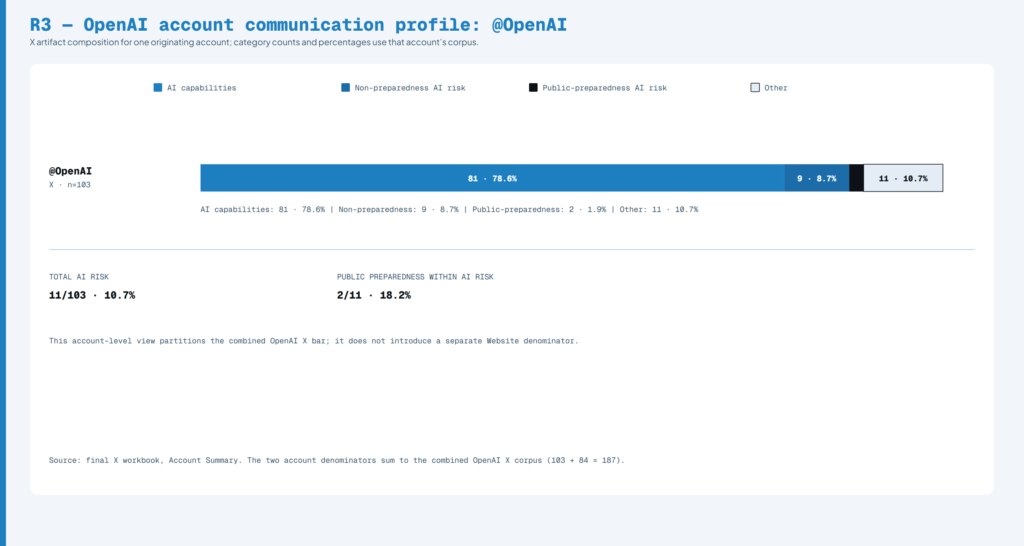
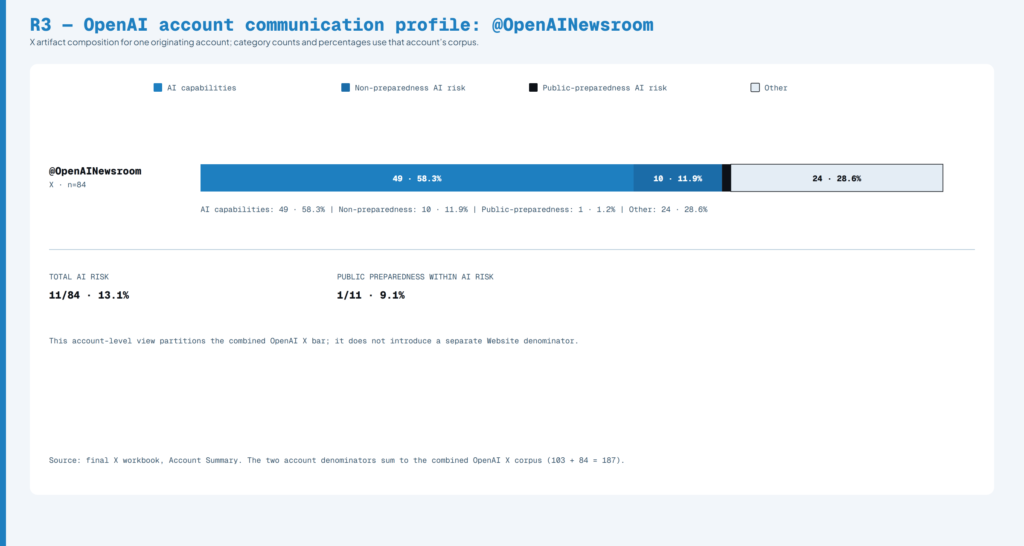
OpenAI, which is the official account (and which had more artifacts for the given period), had a staggering share of its output within the capabilities communication classification, at 78.6% (81), compared to the 8.7% (9) of non-preparedness risk communication published and the 1.9% (2) of public-preparedness risk communication published. On the other hand, 58.3% (49) of the X artifacts from the OpenAINewsroom account fall under the capabilities classification, with 11.9% (10) being non-preparedness risk communication, and 1.2% (1) being public-preparedness risk communication.
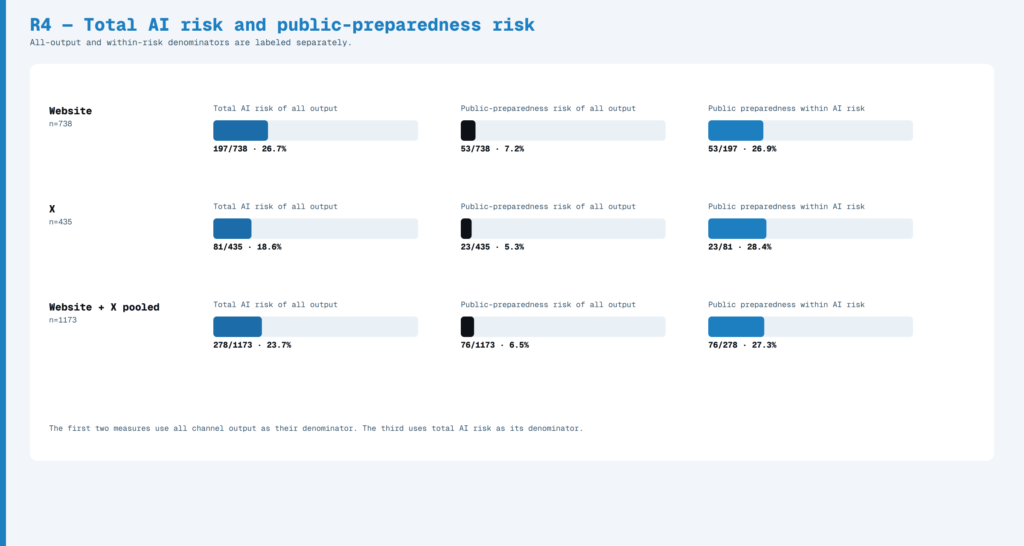
Furthermore, an angle of findings worth considering in discussing the results at the lab-by-lab level is the structural underrepresentation of public-preparedness AI risk communication, even as a share of risk communication generally. Although the output volume for AI risk communication seemed comparatively level with AI capabilities communication and other forms of communication for some accounts (Anthropic’s X especially comes to mind, a comparative analysis of public-preparedness risk communication and blanket, general AI risk communication shows the paucity of public-preparedness outputs. Communication about public preparedness for AI risks was only 26.9% (53) of the total communication about AI risks on the labs’ website during the analysis period (see Image 12 below). Similarly, it was only 28.4% (23) of all X risk-communication outputs and 27.3% (76) when both channels are combined (also in Image 12 below).
1.3 Examining A Shift in Communication Priorities: From Labs’ Websites to X
Another important point is how strategic communication contributes to the structural underrepresentation of public-preparedness AI risk communication. The concept of strategic communication influences what any given organization chooses to communicate, at what level they intensify communication on chosen topics, and which platforms or channels they prioritize over others, including the topics they prioritize on each channel or platform. Thus, a sampled frontier lab’s investment in content type via a channel could signal priorities that are not generalizable to the state of preparedness risk communication’s structural underrepresentation, as aggregated across all sampled labs, or, more so, to a sector-wide level. In examining this phenomenon, we can look at the shift in communication priorities from the website to X. This is because the labs’ websites are their primary and most fundamental channel of communication. Thus, while what goes on the website is a function of strategic communication, what goes on other channels can be said to be a derivative of further strategic considerations about which messaging type to prioritize. In fact, analyzing the shift in communication from a website-to-X perspective makes sense, as the X corpus is predominantly posts promoting longer, more in-depth website publications.
Anthropic
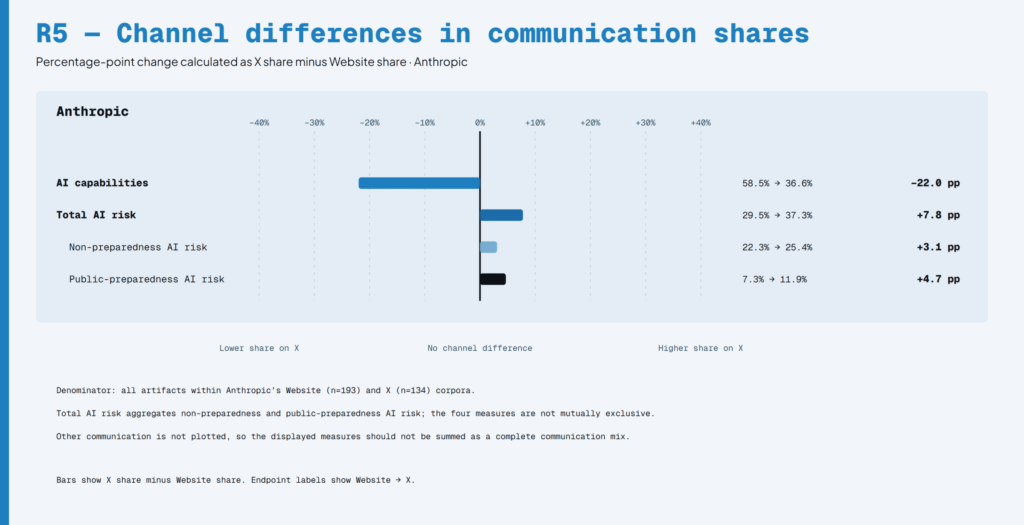
Anthropic’s AI capabilities communication shifted from a higher level of output volume on its website (58.5%) to a much lower level (36.6%). This also has the biggest downward shift in AI capabilities communication among the sampled labs, at 22 percentage points. However, Anthropic’s risk communication saw an upward turn from 29.5% on the website to 37.3% on X, a 7.8 percentage-point increase. This increase is not disproportionately concentrated in one sub-category of risk communication: both non-preparedness AI risk communication (shifting from 22.3% gto 25.4%, at 3.1 percentage points) and public-preparedness AI risk communication (shifting from 7.3% to 11.9%, at 4.7 percentage points) saw an upward turn.
Thus, while the overall understanding is that Anthropic still had a higher output volume for AI capabilities, regardless of the platform, there was a significantly huge drop in the level of communication about AI capabilities on X compared to what they were publishing on their website, and when this is combined with the upward tick for risk communication, it could make it so that should the public interact with Anthropic’s communications more on X than any other platform, Anthropic’s brand image could converge around the “frontier AI lab with intesified risk communication”, whereas, the reality is that Anthropic’s focus on AI capability gains at the detriment of risk communication (both for preparendess and not for preparedness) is comparable to the other sampled labs.
Google DeepMind
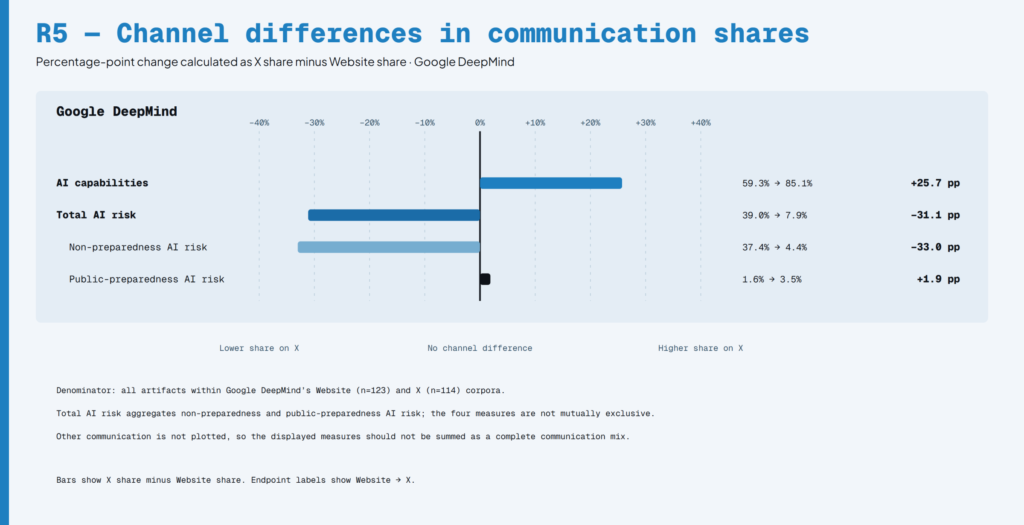
For Google DeepMind, the case is starkly different from Anthropic’s. The lab’s AI capabilities communication saw a huge upward turn from an already high 59.3% on the website to 85.1% on X, that is an increase of 25.7 percentage points, also marking the highest percentage-point increase in AI capabilities communication among the sampled labs. On the other hand, Google DeepMind’s AI risk communication saw a huge downward shift in output volume from website to X (from 39% to 7.9%), a 31.1 percentage-point drop, still the highest percentage-point drop of all sampled labs. This significant drop is caused mainly by a similar shift in non-preparedness risk communication (from 37.4% to 4.4% [33 percentage points]), even though there was a slight upward shift in public-preparedness communication (from 1.6% to 3.5%, a 1.9 percentage-point increase). Thus, Google DeepMind’s priorities for its X communications and engagement intensified around increasing AI capabilities, at the expense of communication about the risks these capabilities pose.
So, if the public mainly interacts with Google DeepMind via its X account, the big upward shift in capabilities communication and downward shift in AI risk communication could shape public perceptions towards thinking Google DeepMind’s AI risk communication is non-existent, even though the lab has a comparably higher AI risk communication output than Anthropic does, when websites are the focal point.
OpenAI
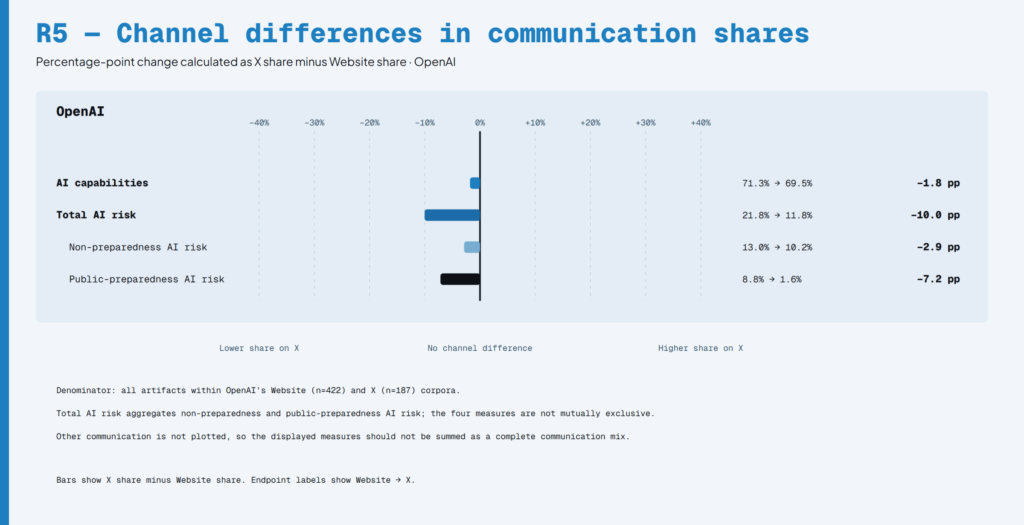
OpenAI’s case is quite different from the other two labs: all categories saw a downward shift, though the magnitude of the decline differed. OpenAI’s communication about AI capabilities shifted from 71.3% of the lab’s total communications on its website to 69.5% of all communications on its X accounts, a 1.8 percentage-point drop. AI risk saw a somewhat significant downward shift from 21.8% to 11.8%, a 10 percentage-point drop. This was primarily due to public-preparedness AI risk communication, which shifted from 8.8% of the website’s total artifacts to 1.6% of the total X artifacts, a 7.2 percentage-point drop. Non-preparedness AI risk communication also saw a slight downward turn, from 13% of website publications to 10.2% of X artifacts, a 2.9 percentage-point shift. Thus, the understanding is that AI capabilities and AI risks communication generally took a smaller percentage share of OpenAI’s communication on its X accounts than they did on its website. Still, that all categories shifted leftward does not mean too much, given the asymmetry in the magnitude of decline, such that if the public interacts more with OpenAI via its X accounts than any other channels, the brand image may converge around claims that OpenAI communicates overwhelmingly about AI capabilities and rarely communicates about AI risks, which would be true, but would not paint the full picture (that is, OpenAI has a comparable level of communication about AI risks to the other two labs, when the website is considered, and especially when it concerns public-preparedness for AI risks).
Having examined the communication output volume from all these dimensions, it is also important to draw a parallel between the dichotomies of this prototreatise’s argument. When public-preparedness risk communication is compared with AI capabilities communication, the structural underrepresentation discussed so far becomes starkly evident (see the image below). The magnitude of the asymmetry varied considerably by channel type and also by lab. However, there was no lab-channel combination in which public-preparedness risk communication exceeded capabilities communication in terms of output volume. Furthermore, the smallest gap, indicating the smallest volume-based underrepresentation, appeared in Anthropic’s X communication, at 24.7 percentage points (which is still a lot), while the biggest gap appeared in Google DeepMind’s X communication, at 81.6 percentage points.
Revisiting the Position
This prototreatise set out with very strong claims:
(i) There are increasing AI capability gains signaling that insanely capable and powerful AI might be here soon, and that it might be broadly diffused.
(ii) The likelihood of that happening poses enormous risks that we probably have not fully accounted for.
(iii) No one is as close to the pulse as frontier AI labs; these labs are best able to tell how close we are to this described AI (note, which necessarily doesn’t have to be AGI or ASI).
(iv) The world is not nearly ready for such AI; thus, the importance of AI risk communication for public preparedness.
(v) No one is better positioned for this AI risk communication for public preparedness than frontier AI labs (not even governments all over the world). Why? The models are by the labs (and there’s evidence to suggest internal models are often light years ahead of external models), there’s financial resources to support broadly disseminated communication and implement strategies to ensure it is effective, and no one has as much context and data to evaluate the risks of these AI models as their creators.
(vi) Frontier AI labs are not currently incentivized to communicate AI risks in a way that prepares the public. This is not a case of labs being evil, or even them being self-serving (or maybe it’s somewhat about the latter). It’s just that the incentive scales are heavily tilted towards this phenomenon: there is demonstrable proof, and reasons why labs will invest heavily in communication capabilities, while labs cannot help but communicate technically about the risks they observe; industrial standards and, in some cases, government requirements make it so. What is to incentivize preparing the public for AI risks when the goal is to ramp up AI adoption, and especially when it is most likely genuinely believed internally at most of these labs that they have the resources and capabilties to bring safe, aligned, yet capable (maybe AGI) to market (even if they may be overestimating their resources and capacities, there is a difference between what is believed to be true and what may be true)?
(vii) Thus, frontier AI labs’ communication about AI risks in a way that prepares the public is structurally underrepresented, and especially when compared to communication about AI capabilities.
If anything, the analysis of communication artifacts from Anthropic, Google DeepMind, and OpenAI has shown that there is indeed a structural underrepresentation of AI risk communication at a concerning magnitude. Recent sandbox-breaking incidents from OpenAI and Anthropic models, and especially the early signs of AI civilization demonstrated by OpenAI models in the months leading up to the Hugging Face hacking incident are evidence that the machinations of powerful AI models can be real, and that we have moved past the phase where models with such capabilities to exploit zero-day capabilities are still general viewed within the “this is capable, but we have things under control and will bring a safe and aligned model to market” purview. That is not to say Fable, Mythos, Sol 5.6, or other similarly capable models that are broadly or relatively broadly available are models of especial concern. However, the body language and communication direction of AI labs, at the institutional or sectoral level, have been laissez-faire about the possibility of things getting fully out of control (well, not until recently).
This body language and direction or understanding, which may not be unconnected to the perceived adequacy of the resources and capabilities available within frontier labs, as I previously mentioned, could very well be the guiding orientation or a strong factor for why LLMs are seemingly being de-anthropomorphized, and intentionally too. If we consider that Anthropic, Google DeepMind, and OpenAI are the quintessence of the AI sector/industry, given that they are classified as frontier labs, have attracted the deepest and broadest concentration of talent, have some of the biggest user bases, are increasingly ramping up their hiring in key areas, and have some of the most profound financial resources at their disposal. Essentially, if no other AI lab beats these three within the full consideration of the factors listed, we can say that the sampled labs are the leading AI labs (both at present and also regarding how well-positioned they are to lead in the future).
The findings indicate that, regardless of the brand strategies, posturing, and positioning of these three labs, they are essentially the same peas in a pod regarding public preparedness for AI risks. And if the leading labs are this way, I am more inclined to believe and posit that things are even worse with most other AI labs. The realization of this dearth of well-oriented risk communication is concerning. An industry geared towards increasing, multi-format, and strategic capabilities communication, but comparatively sparse public-preparedness risk communication leaves publics, institutions, and decision-makers with less material through which to understand, judge, and prepare for the risks being foregrounded in this work. This structural underrepresentation requires industry-wide rallying for solutions (a pathway not new to industry players, as seen recently with the Pace the Frontier initiative).
Propositions and Recommendations
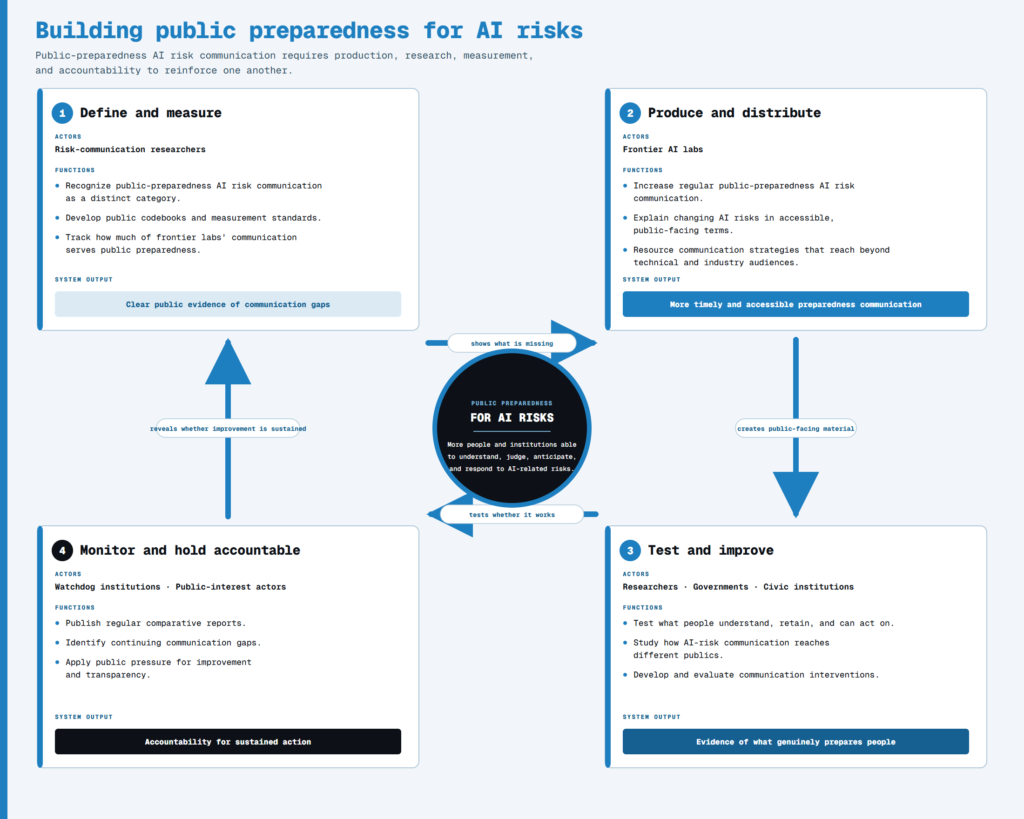
I will wrap up this prototreatise by presenting propositions and recommendations, which I believe can help address the issues raised in this work. There are four propositions and recommendations. They are not siloed or disconnected, one from the other. They are not necessarily sequential. They also address different facets of the problem, but can be beneficial when considered together. They are presented in subsequent paragraphs.
A Case for Public Preparedness AI Risk Communication as a Category
This work has alternated between public-preparedness risk communication and the broader risk communication term in a way that might make the work harder to follow for some. I understand and will concede to that being one of the downsides of this treatise. However, it is also evidence that there is a need to consider risk communication for public preparedness as a recognized and existing category. This will allow for more focus on that dimension of risk communication, especially as it has been demonstrated to be a growing concern. Furthermore, it will allow for more work (research, measurement, watchdogging, strategy) that’s better attuned to getting results aligned with the goal of preparing humanity for the risks of AI. General safety, governance, and risk language and communications in the AI industry and sector do not currently and cannot fully serve this purpose. This is why Anthropic, with increased AI risk communication on its X account, could still not meet the purpose of this type of risk communication because it is not just about communicating risks.
Frontier AI Labs Need to Invest More in AI Risk Communication for Public Preparedness
One core point I have consistently argued is that frontier AI labs are best positioned to assess AI capabilities and, as such, perhaps have the deepest understanding of what AI risks are shaping up to be and which risks are looking even more likely. I must acknowledge that this past year has seen increasing efforts (especially by Anthropic and OpenAI) to understand the effects of AI capability gains on the economy, cybersecurity, bio, and some other endeavors. They carry this out through internal research and fellowships. Thus, there is seemingly evergreen content that falls outside the analysis period but remains relevant to boosting public preparedness. The same argument can be made for other resources these labs have created through platforms such as OpenAI Academy. As such, the data in this work should not be taken at the absolute time-value level.
Nonetheless, content staleness is real, and by that standard, these frontier AI labs create fresh content on AI capabilities at a rate that sidelines their work on public preparedness for AI risks. Granted, communication is not inherently effective communication (so, doing more doesn’t guarantee good results), however, the volume of representation is a contributory factor towards visibility, and as such, to have single-digit percentages of public-preparedness AI risk communication is to not give that content category a fair chance at reaching people and being effective.
Thus, frontier AI labs need to ramp up their efforts in AI risk communication for public preparedness. This is a call on Anthropic, Google DeepMind, OpenAI, SpaceXAI, and MetaAI, among other frontier AI labs, to increase capacities in this domain: hiring more risk communication experts; launching internal initiatives on how to make this type of communication far-reaching and effective; transparent reporting of their communication efforts on AI risk communication for public preparedness, among other endeavors to look into. In fact, this could readily be a joint venture among frontier AI labs; we are past the era of siloed work, especially when it comes to the safety of the world’s peoples and adequately preparing for potential AI risks.
Intensified Applied Risk Communication Research on AI Risks and Public Preparedness
I will also call on risk communication researchers to intensify research on AI risks and public preparedness for them. This is an endeavor that concerns academic institutions and governments alike. Understandably, taking an AI pathway may not look rosy given years of expertise and dedication to another risk pathway (e.g., health risks, environmental risks). However, AI development is such that AI models in the near future may very well pose multidimensional risks that overlap with or subsume the risks we are concerned about and invested in researching today.
There is a need for more inquiries into AI risks, intensified, strategically positioned student recruitment efforts, collaborative research, framework development, conceptualization and operationalization of terms, and, more importantly, applied research aimed at providing pathways for making AI risk communication far-reaching and effective.
Watchdog Institutions Focused on AI Labs’ Public-Preparedness Risk Communication Efforts
Lastly, there is a need for newer watchdog institutions to emerge. Again, the structural underrepresentation of public-preparedness AI risk communication is most likely tied to a lack of incentives. As such, frontier AI labs need to be rejigged to raise awareness of this major concern and the role they can play. There are only two categories of societal infrastructure that can make this rejigging possible: governments and respected watchdog institutions. The work that watchdog institutions already do in AI safety, AI alignment, and AI governance is commendable. However, now is the time for new watchdog institutions to emerge, with a primary focus on public preparedness for AI risks. They will need to be committed to putting intense pressure on actors to ensure effective, broad-reaching AI risk communication efforts towards this preparedness.
If these interventions are put in place, we should start to see structured, strategic, and effective work that ensures those outside the deep-knowledge AI bubble are adequately prepared for AI risks.
References
- Aaron Gertler, & 80,000 Hours team. (2026, 05 15). Preventing Catastrophic Pandemics. 80,000 Hours. Retrieved 2026-07-31. https://80000hours.org/problem-profiles/preventing-catastrophic-pandemics/ Return to citation
- Amodei, D. (2024, October). Machines of loving grace: How AI could transform the world for the better. https://darioamodei.com/essay/machines-of-loving-grace Return to citation
- Ananya Gairola. (2026, 02 21). Demis Hassabis Predicts AGI Will Have 10x The Impact Of The Industrial Revolution — And It Will Happen In A Decade, Not A Century. Yahoo Finance. https://finance.yahoo.com/news/demis-hassabis-predicts-agi-10x-143113425.html Return to citation
- Anthony M. Barrett, & Seth D. Baum. (2017). A model of pathways to artificial superintelligence catastrophe for risk and decision analysis. Journal of Experimental & Theoretical Artificial Intelligence, 29(2), 397–414. https://doi.org/10.1080/0952813x.2016.1186228 Return to citation
- Barbara Reynolds, & Matthew W. Seeger. (2005, 01). Crisis and Emergency Risk Communication as an Integrative Model. Journal of Health Communication, 10(1), 43–55. https://doi.org/10.1080/10810730590904571 Return to citation
- Center for AI Safety. (2023, 05 30). Statement on AI Risk. Israeli Association for Ethics in Artificial Intelligence. Retrieved 2026-07-30. https://www.iaeai.org/tpost/xa4htcma61-statement-on-ai-risk Return to citation
- COVID-19 National Preparedness Collaborators. (2022, 04 16). Pandemic preparedness and COVID-19: An exploratory analysis of infection and fatality rates, and contextual factors associated with preparedness in 177 countries, from Jan 1, 2020, to Sept 30, 2021. The Lancet, 399(10334), 1489–1512. https://doi.org/10.1016/s0140-6736(22)00172-6 Return to citation
- Deanna D. Sellnow, Derek R. Lane, Timothy L. Sellnow, & Robert S. Littlefield. (2017, 10 20). The IDEA Model as a Best Practice for Effective Instructional Risk and Crisis Communication. Communication Studies, 68(5), 552–567. https://doi.org/10.1080/10510974.2017.1375535 Return to citation
- Demis Hassabis. (2026, 07 14). A Framework for Frontier AI and the Dawning of a New Age. X. Retrieved 2026-07-30. https://x.com/demishassabis/article/2076957440109625718 Return to citation
- Goldman Sachs Research. (2025, 08 13). How Will AI Affect the Global Workforce? Goldman Sachs. Retrieved 2026-07-31. https://www.goldmansachs.com/insights/articles/how-will-ai-affect-the-global-workforce Return to citation
- Hsiu-Fang Hsieh, & Sarah E. Shannon. (2005, 11). Three Approaches to Qualitative Content Analysis. Qualitative Health Research, 15(9), 1277–1288. https://doi.org/10.1177/1049732305276687 Return to citation
- Jake Angelo. (2026, 05 16). Microsoft AI chief gives it 18 months—for all white-collar work to be automated by AI. Fortune. https://fortune.com/article/why-microsoft-ai-chief-mustafa-suleyman-predicts-ai-automation-18-months/ Return to citation
- Jamie K. Wardman. (2008, 12). The Constitution of Risk Communication in Advanced Liberal Societies. Risk Analysis, 28(6), 1619–1637. https://doi.org/10.1111/j.1539-6924.2008.01108.x Return to citation
- Jan Kulveit, Raymond Douglas, Nora Ammann, Deger Turan, David Krueger, & David Duvenaud. (2025, 01 28). Gradual Disempowerment: Systemic Existential Risks from Incremental AI Development [Preprint]. arXiv. https://doi.org/10.48550/arxiv.2501.16946 Return to citation
- METR. (2026, 05 08). Task-Completion Time Horizons of Frontier AI Models. Retrieved 2026-07-30. https://metr.org/time-horizons/ Return to citation
- Michael K. Lindell, & Ronald W. Perry. (2012, 04). The Protective Action Decision Model: Theoretical Modifications and Additional Evidence. Risk Analysis, 32(4), 616–632. https://doi.org/10.1111/j.1539-6924.2011.01647.x Return to citation
- National Research Council. (1989). Improving Risk Communication. National Academies Press. https://doi.org/10.17226/1189 Return to citation
- Pia-Johanna Schweizer, Robert Goble, & Ortwin Renn. (2022, 07). Social Perception of Systemic Risks. Risk Analysis, 42(7), 1455–1471. https://doi.org/10.1111/risa.13831 Return to citation
- Prarthana Prakash. (2023, 04 17). Alphabet CEO Sundar Pichai says that A.I. could be ‘more profound’ than both fire and electricity—but he’s been saying the same thing for years. Fortune. https://fortune.com/2023/04/17/sundar-pichai-a-i-more-profound-than-fire-electricity/ Return to citation
- Sam Altman. (2025, 06 10). The Gentle Singularity. Sam Altman's Blog. Retrieved 2026-07-30. https://blog.samaltman.com/the-gentle-singularity Return to citation
- Scott McLean, Gemma J. M. Read, Jason Thompson, Chris Baber, Neville A. Stanton, & Paul M. Salmon. (2023). The risks associated with Artificial General Intelligence: A systematic review. Journal of Experimental & Theoretical Artificial Intelligence, 35(5), 649–663. https://doi.org/10.1080/0952813x.2021.1964003 Return to citation
- Thomas Larsen, Romeo Dean, Brendan Halstead, Eli Lifland, Ryan Greenblatt, & Daniel Kokotajlo. (2026, 07 09). AI 2040: Plan A. AI Futures Project. https://ai-2040.com/ Return to citation
- Vincent T. Covello. (1992, 01). Risk Communication: An Emerging Area of Health Communication Research. Annals of the International Communication Association, 15(1), 359–373. https://doi.org/10.1080/23808985.1992.11678816 Return to citation
- William Leiss. (1996, 05). Three Phases in the Evolution of Risk Communication Practice. The ANNALS of the American Academy of Political and Social Science, 545(1), 85–94. https://doi.org/10.1177/0002716296545001009 Return to citation
- Åsa Boholm. (2019, 08). Risk Communication as Government Agency Organizational Practice. Risk Analysis, 39(8), 1695–1707. https://doi.org/10.1111/risa.13302 Return to citation
You reached the end of this article.